
BHNCDSB Course Calendar 2027-2028
As a Catholic learning community, supporting each other in our faith journey, we provide academic excellence within a safe, Christ-centred environment while enabling all individuals to become life-long learners who make a positive contribution to society.
To view course options and prerequisite requirements, please select your school from below and visit their departments page.
CATHOLICITY
Ontario Catholic Graduate Expectations
- A discerning believer formed in the Catholic Faith community who celebrates the signs and sacred mystery of God’s presence through word, sacrament, prayer, forgiveness, reflection, and moral living.
- An effective communicator, who speaks, writes, and listens honestly and sensitively, responding critically in light of gospel values.
- A reflective, creative, and holistic thinker who solves problems and makes responsible decisions with an informed moral conscience for the common good.
- A self-directed, responsible, lifelong learner who develops and demonstrates their God-given potential.
- A collaborative contributor who finds meaning, dignity and vocation in work, which respects the rights of all and contributes to the common good.
- A caring family member who attends to family, school, parish, and the wider community.
- A responsible citizen who gives witness to Catholic social teaching by promoting peace, justice, and the sacredness of human life.
Code of Human Relations
The Code of Human Relations outlines to our staff, students, parents/guardians, and visitors the basic values which our community uses to make decisions. It explains the expectations we have of each other, the supports which are in place to encourage us in our daily routines, and the possible consequences should we decide to ignore the expectations.
The expectations and consequences associated with irregular attendance, absences and late arrivals are clearly outlined in our Code of Human Relations. These policies and procedures are found in the student planner, which is issued to the students at the beginning of each school year.
Choosing to respect the content and the intent of the Code of Human Relations will allow each person to be successful in his/her academic pursuits and will allow everyone to work and study in an environment which nurtures his/her individual potential.
Campus Ministry
Campus Ministry is dedicated to providing a ministry of presence to all its members. On a pastoral level, Campus Ministry provides a listening ear and a helping hand. It also acts as a liaison to the local parishes. As a Christ-centered community, this ministry co-ordinates morning reflections, liturgies, reconciliation services and retreats. The Brant Haldimand Norfolk Catholic District School Board is committed to celebrating this vision of Christ.
The role of the Chaplaincy Leader is to build healthy, supportive relationships, in light of gospel values, with the students and staff. The love and example of Christ and His Church would then be passed on through these relationships and various activities. Since school chaplaincy is a pastoral care role carried out in an educational setting, it is understood that the person in the role of Chaplaincy Leader contributes his/her expertise and talents to the continuation and enhancement of Catholic faith and religious education within their community
GRADUATION REQUIREMENTS
Enrollment Requirements
All secondary students are required to meet the requirements of full-time students:
- Grade 9 and Grade 10 students must be enrolled in 4 credits per semester
- Grade 11 students must be enrolled in 4 credits per semester, unless permission is given by principal or designate.
- Grade 12 students must enroll in a minimum of 3 credits per semester
- Returning Grade 12 graduates must enroll in a minimum of 2 credits per semester
Enrollment for returning Grade 12 graduates is not guaranteed and will be determined by the principal or designate.
Exceptions to the requirement for full-time student status may be allowed by the principal or designate, only in exceptional circumstances.
Principals Honour Roll
Students who qualify for Principal’s Honour Roll must achieve:
- Students in Grades 9 and 10 – 80% average in minimum eight courses and be recognized as a full-time student as defined above from September – June.
- Students in Grade 11 – 80% average in minimum eight courses and be recognized as a full-time student as defined above from September – June, unless permission for a reduced courseload is given by the principal.
- Students in Grade 12 – 80% average in minimum six courses and be recognized as a full-time student as defined above from September – June.
The Principal’s Honour Roll is calculated on all courses taken from July 1- June 30 of the school year. Only courses registered through BHNCDSB are eligible for inclusion in the Honour Roll criteria. In all grades, students must have a grade-level Religion course and meet eligibility requirements for a full-time student as defined above.
Ontario Secondary School Diploma Requirements
For Students entering Grade 9 in September 2024 or later
- English (4 credits – one credit per grade)
- Mathematics (3 credits, Grade 9, Grade 10, and one in Grade 11 or 12)
- Science (2 credits)
- French as a second language (1 credit)
- Canadian geography (1 credit)
- Health and Physical Education (1 credit)
- The arts (1 credit)
- Careers (1/2 credit)
- Civics (1/2 credit)
- Technology (1 credit, grade 9 or 10)
- 1 additional STEM-related credit from the group below
STEM-related group:
- Business credit
- Computer studies
- Cooperative education
- Mathematics (in addition to the 3 compulsory credits required)
- Science (in addition to the 2 compulsory credits required)
- Technological education (in addition to the 1 compulsory credit required)
You must also complete:
- 4 religion credits
- 9 optional credits
- Ontario Secondary School Literacy Test (Grade 10)
- Financial Literacy requirement (Grade 10)
- 40 hours of community service over four years
- 2 online learning courses
For students entering Grade 9 in September 2023 or earlier
- English (4 credits – one credit per grade)
- Mathematics (3 credits, at least one in Grade 11 or 12)
- Science (2 credits)
- French as a second language (1 credit)
- Canadian geography (1 credit)
- Health and Physical Education (1 credit)
- The arts (1 credit)
- Careers (1/2 credit, grade 10)
- Civics (1/2 credit, grade 10)
One from Group 1 choice:
Additional English, or French as a second language, or Native language, or a classical or an international language, or social science and the humanities, or Canadian and world studies, or guidance and career education, or cooperative education.
One from group 2 choices:
Additional health and physical education, or the arts, or business studies, or French as a second language, or cooperative education.
One from group 3 choices:
Additional science (Grade 11 or 12), or technological education or computer studies, or French as a second language, or cooperative education.
You must also complete:
- 4 religion credits
- 8 optional credits
- Ontario Secondary School Literacy Test (Grade 10)
- 40 hours of community service over four years
- 2 online learning courses
Ontario Secondary School Certificate
The Ontario Secondary School Certificate will be granted on request to students who leave school before earning the Ontario Secondary School Diploma, if they have earned a minimum of 14 credits distributed as follows:
Compulsory credits (total of 7)
- 2 credits in English
- 1 credit in Canadian geography or Canadian history
- 1 credit in mathematics
- 1 credit in science
- 1 credit in health and physical education
- 1 credit in the arts or technological education
Optional credits (total of 7) credits selected by the student from available courses, including one religious education credit per year
Certificate of Accomplishment
Students who leave school before fulfilling the requirements for the Ontario Secondary School Diploma or the Ontario Secondary School Certificate may be granted a Certificate of Accomplishment. This Certificate of Accomplishment may be a useful means of recognizing achievement for students who plan to take certain vocational programs or other kinds of further training, or who plan to find employment after leaving school
Community Involvement
As part of the diploma requirements, students are required to complete a minimum of 40 hours of community involvement activities. These activities may be completed at any time during their years in the secondary program. The community involvement requirement is designed to provide an opportunity for students to meet the Catholic Graduate
COURSE OPTIONS
The types of courses offered and their organization provide for a graduated streaming of courses in Grades 9 to 12, which will keep options open for all students in the earlier grades and prepare students in senior grades for their future destination. In Grade 9, students work at the De-streamed and open level and in Grade 10, there are three types of courses offered: academic, applied, and open. Courses in Grades 11 and 12 are designed to prepare students for a post-secondary destination – that is, for apprenticeship training, college, university, or the workplace.
Types of Courses in Grades 9 and 10
Students with their parents/guardians and teachers choose Grades 9 and 10 courses based primarily on student interests, needs and achievements. In these years, students select an appropriate combination of open, applied, and academic courses to add to their knowledge and skills base, explore their interests, and determine the type of educational program they are best suited to undertake. Students are not required to make binding decisions about a particular educational and career path.
De-streamed Course “W”
These courses encourage student success within a de-streamed classroom environment where classroom educators employ a variety of culturally responsive instructional strategies and collaborate with colleagues to create an engaging and relevant experience for students.
Academic Courses “D”
Academic courses develop students’ knowledge and skills through the study of theory and abstract problems. These courses focus on the essential concepts of a subject and explore related concepts as well. They incorporate practical applications as appropriate.
Applied Courses “P” (Grade 10 only)
Applied courses focus on the essential concepts of a subject and develop students’ knowledge and skills through practical applications and concrete examples. Familiar situations are used to illustrate ideas, and students are given more opportunities to experience hands-on applications of the concepts and theories they study.
Locally Developed Compulsory Credit Courses (LDCC) “L”
LDCC courses focus on the knowledge and skills that students need to be well prepared for success in the Grade 11 Workplace Preparation courses. Students with widely ranging levels of competency may require these courses; some of these students may be four years behind grade level with significant gaps in knowledge, concept understanding, and skills. As well, LDCC courses will support students in developing and enhancing strategies that they need to develop literacy and numeracy skills and the confidence to use these skills in their day-to-day activities.
Open Courses “O”
Open courses are the only types of courses offered in most subjects other than those listed above. They are designed to prepare students for further study in a subject, and to enrich their education generally. Open courses comprise a set of expectations that are appropriate for all students.
Grade 10, academic and applied courses will prepare students for Grade 11 courses, for which prerequisites are specified in the curriculum policy documents for Grades 11 and 12.
Types of Courses in Grades 11 and 12
In Grades 11 and 12, students will choose from among four destination-related course types: university preparation, university/college preparation, college preparation, and workplace preparation. Open courses are also offered in Grades 11 and 12. Students will make their choices based on their interests, achievement, and career goals. All university preparation courses, university/college preparation courses, college preparation courses, and workplace preparation courses have been developed in collaboration with representatives of universities, colleges, apprenticeship programs, or the business community, as appropriate, and are designed to enable students to meet the entrance requirements of post-secondary institutions or apprenticeship or other training programs, or the expectations of employers in the workplace.
The following is a brief description of the types of courses that are available in the various disciplines of the Ontario curriculum in Grades 11 and 12:
University Preparation Courses “U”
University preparation courses are designed to equip students with the knowledge and skills they need to meet the entrance requirements for university programs.
University/College Preparation Courses “M”
University/college preparation courses are designed to equip students with the knowledge and skills they need to meet the entrance requirements for specific programs offered at universities and colleges.
College Preparation Courses “C”
College preparation courses are designed to equip students with the knowledge and skills they need to meet the requirements for entrance to most college programs or for admission to apprenticeship or other training programs.
Workplace Preparation Courses “E”
Workplace preparation courses are designed to equip students with the knowledge and skills they need to meet the expectations of employers, if they plan to enter the workplace directly after graduation, or the requirements for admission to certain apprenticeship or other training programs.
Open Courses “O”
Open courses are designed to broaden students’ knowledge and skills in subjects that reflect their interests and to prepare them for active and rewarding participation in society. They are not designed with the specific requirements of universities, colleges, or the workplace in mind.
Prerequisites are specified for many of the courses offered in Grades 11 and 12. They are identified in the curriculum policy documents.
Transfer Courses
A transfer course is a partial-credit course that bridges the gap between courses of two different types in the same subject and grade. Students who revised their educational and career goals and who wish to change from one destination related stream to another in a particular subject may often do so by taking a transfer course. Transfer courses enable students to achieve the expectations not covered in one course type but required for entry into a course in the next grade. For example, the prerequisite for the Grade 11 university preparation course in English is the Grade 10 academic course in English. A student who is taking the applied English course in Grade 10 but who decides to enter the university preparation course in Grade 11 may do so by taking a transfer course. Transfer courses will be offered for students who wish to change from one course type to another in the same subject between Grade 10 and Grade 11 or between Grade 11 and Grade 12.
ASSESSMENT AND EVALUATION
ASSESSMENT AND EVALUATION
Assessment and evaluation will be based on the provincial curriculum expectations and the achievement levels outlined in the document Growing Success – Assessment, Evaluation, and Reporting in Ontario Schools 2010 and in the curriculum policy document for each discipline. A final grade is recorded for every course, and a credit is granted and recorded for every course in which the student’s grade is 50% or higher. The final grade for each course in Grades 9 to 12 will be determined as follows:
- 70% of the grade will be based on evaluations conducted throughout the course. This portion of the grade should reflect the student’s most consistent level of achievement throughout the course, although special consideration should be given to more recent evidence to achievement.
- 30% of the grade will be based on a final evaluation in the form of a culminating project, portfolio, examination, performance, essay, and/or other method of evaluation suitable to the course content and administered towards the end of the course.
In all their courses, students must be provided with numerous and varied opportunities to demonstrate the full extent of their achievement of the curriculum expectations, across all four categories of knowledge and skills.
SUBSTITUTE FOR COMPULSORY COURSES
To allow flexibility in designing a student’s program and to ensure that all students can qualify for the secondary school diploma, substitutions may be made for a limited number of compulsory credit courses. Administrators may replace up to three compulsory courses with courses from the remainder of those that meet the compulsory credit requirements.
CANCELLATION OF COURSES
When there is an insufficient number of requests for a course, as defined by the administrator, that course will be cancelled at the school, at least for that school year.
COURSE CHANGES
Course changes for the next school year can be made until the end of June. All timetable changes must go through the Student Services Department. Students must have a good reason for requesting timetable changes (e.g., repeating a failed course, vocational changes, etc.) As with original course selections, all transfers, or changes of course by students under 18 must also receive parents/guardians approval.
EQAO GRADE 9 ASSESSMENT OF MATHEMATICS
The EQAO Grade 9 Assessment of Mathematics is conducted each year. All students enrolled in Grade 9 Mathematics write the assessment. The purpose is to identify strengths and areas for improvement in student learning. This assessment is not a diploma requirement.
For students enrolled in ESL/ESD programs, special provisions may be made in accordance with EQAO guidelines.
For students with special education needs, policies and guidelines will be provided to accommodate their situations. An Individual Education Plan (IEP) is required if a student is to receive accommodations. Exemptions may be given for special needs students and ESL/ESD students where it is determined that accommodations or special provisions still would not enable the students to
STUDENT SERVICES
THE GUIDANCE PROGRAM
The Guidance Program is a vital and integral part of the total school curriculum. The primary focus of Student Services is to enhance the dignity of everyone by encouraging each student’s sense of self-worth and a feeling of belonging.
In all facets of school life, the guidance counsellor teacher’s foster each student’s ability to:
- Know and appreciate themselves
- Relate effectively with others
- Develop appropriate educational plans
- Design personal career paths
ACADEMICS
Guidance counsellors can assist with the selection of suitable courses and programs, establishing timetables, study habits, organization of time, exam preparation and review.
INFORMATION/CAREER PLANNING
The Guidance Centre provides a variety of sources by which students can research career options, employment trends, post- secondary sites (college, apprenticeship, world of work, specialized post-secondary schools, or university programs) as well as admission requirements to post-secondary destinations.
The centre has several computers as well as a variety of resources for individual student use in career and post-secondary planning. The department also arranges for college and university information, programs, welcomes guest speakers, and shares scholarship information.
PERSONAL COUNSELLING AND COMMUNITY SERVICES
The guidance counsellors, child & youth workers, chaplain, special education teachers, and Student Success teachers, provide a multifaceted, interdisciplinary team which classroom teachers and/or individual students may access. As needed, further assistance is available via community agencies.
EMPLOYMENT SERVICES
Information concerning part-time and full-time employment is available through local Career Resource Centres.
ONTARIO STUDENT RECORD
The Ontario Student Record (OSR) is the official record for a student. Every Ontario school keeps an OSR for each student. The OSR contains achievement results, credits earned, and diploma requirements completed, and other information important to the education of the student. Every student is entitled to examine his or her record. A parent or guardian of a student who has not reached the age of majority is also entitled to examine the record.
ONTARIO STUDENT TRANSCRIPT
The Ontario Student Transcript (OST) provides a comprehensive record of the credits that a secondary school student has earned towards fulfillment of the requirements for the graduation diploma. This record includes all the credits gained by the student using regular study and correspondence, independent study, private study, continuing education, and summer school.
The transcript, which is part of the Ontario Student Record (OSR), includes the following information:
- A list of all the Grade 9 and 10 credits achieved with percentage grades
- A list of all Grades 11 and 12 courses taken or attempted by the student, with the percentage grades earned and the credits gained (students repeating a course for which they have already earned a credit will earn only one credit for the completion of that course)
- Identification of any course that has been substituted for one that is a diploma requirement
- Confirmation that the student has completed the community involvement requirement
- Confirmation of successful completion of the Grade 10 literacy requirement
- An indication of any extraordinary circumstances affecting the student’s achievement in a Grade 11 or 12 course
In addition to recording the number of credits earned, schools may indicate on student’s transcript that the student has taken a program in a specialized school.
FULL DISCLOSURE
As a result of legislation passed (as of September 1999) all attempts at a senior course (Grade 11 or 12) whether successful or not will be recorded on the transcript. Repeated courses will be shown on the transcript. Both marks will show but only one credit will be granted. Courses withdrawn from (after 5 teaching days following the mid-semester report) will be recorded on the OST with the grade at the time.
WITHDRAWAL FROM A COURSE
Withdrawals from Grades 9 and 10 courses are not recorded on the OST. Only successfully completed courses are recorded on the OST. If a student withdraws from a Grade 11 or 12 course after five instructional days following the issue of the first provincial report card in a semestered or a non-semestered school, the withdrawal is recorded on the OST by entering “W” in the “credit” column. The student’s percentage grade at the time of the withdrawal is recorded in the “percentage grade” column.
REPETITION OF A COURSE
Students who repeat a grade course that they have previously completed successfully earn only one credit for the course. However, for Grade 11 or 12 courses, each attempt and the percentage grade obtained is recorded on the OST, and an “R” is entered in the “credit” columns for the course(s) with the lower percentage grade.
SPECIAL INDICATOR
A student’s parents/guardians or a student who is an adult (18 years of age or over) may request that the administrator identify Grades 11 and 12 courses in which the student’s performance was affected by extraordinary circumstances by using a special indicator. If the administrator agrees with the student’s or parents/guardian’s’ claim, the special indicator “S” is entered in the “note” column for these courses. However, the student’s percentage grades are also recorded.
PRIOR LEARNING ASSESSMENT AND RECOGNITION (PLAR)
Prior learning includes the knowledge and skills that students have acquired, in both formal and informal ways, outside secondary school. Where such learning has occurred outside Ontario classrooms, students enrolled in Ontario secondary schools and inspected private schools may have their skills and knowledge evaluated against the expectations outlined in provincial curriculum policy documents to earn credits towards the secondary school diploma. This formal evaluation and accreditation process is known as Prior Learning Assessment and Recognition (PLAR). PLAR procedures are carried out under the direction of the school administrator, who grants credits. See your guidance department for more information.
STUDENT SUCCESS TEACHERS
Student success teachers are guidance counsellors whose focus is every student’s success. They identify and support struggling students, provide more options for learning, and monitor student progress. They work with school staff, students, parents/guardians, and the community to ensure more students earn the credits necessary to graduate.
SUPPORT FOR ENGLISH LANGUAGE LEARNERS
English as a Second Language (ESL)
Courses in English as a Second Language are designed to assist students develop proficiency in English as well as social and cultural knowledge to enable them to be successful in the secondary school program. ESL courses are credit-bearing and not grade specific. A maximum of 3 credits in English as a second language (ESL) or English literacy development (ELD) may be counted towards the 4 compulsory credits in English, but the fourth must be a credit earned for a Grade 12 compulsory English course. Students may take up to two ESL courses per year. Please discuss ESL course options with your child’s Grade 8 teacher or the secondary school’s guidance staff.
English Literacy Development (ELD)
Courses in English Literacy Development (ELDAO – ELDEO) assist students to develop literacy skills, proficiency in English and social and cultural knowledge to enable them to be successful in the secondary school program. ELD courses are designed for English language learners with limited prior schooling who have not had opportunities to develop age-appropriate literacy skills in any language. ELD courses are credit-bearing and not grade specific. A maximum of 3 credits in English as a second language (ESL) or English literacy development (ELD) may be counted towards the 4 compulsory credits in English, but the fourth must be a credit earned for a Grade 12 compulsory English course. Students may take up to two ELD courses per year. Please discuss ELD course options with your child’s Grade 8 teacher or the secondary school’s guidance staff.
STUDENTS WITH SPECIAL EDUCATION NEEDS
SPECIAL EDUCATION DEPARTMENT
The development of each student’s abilities and potential is a shared responsibility. It is the role of the Special Education Department staff to work with parents/guardians, students, teachers, school personnel, and community agencies to provide options for success of all students. This shared and collaborative model provides services which are delivered primarily within the regular classroom by the course teachers and supported by the Special Education Resource staff. Together, goals are set, and a plan of action is created to assist students in reaching these goals. Some students may have an Individual Education Plan (IEP) for which accommodations, instructional strategies, and assessment methods are specific to the strengths and needs of that individual student. The Special Education Resource staff work with the students to assist them in better understanding their exceptionality and identify accommodations necessary for course success. The student becomes responsible for working with individual classroom teachers for precise accommodations and responsibilities in each class. This process enhances student self-awareness and self-advocacy skills and empowers them to have voice in seeking assistance and strategies necessary for success.
The Special Education Department offers a variety of services and programs to assist students in their secondary school experience and making the transition to post-secondary life.
LEARNING STRATEGIES (GLE)
The Learning Strategies course introduces students to learning theories and strategies that help them increase their personal management skills in school and in other contexts of life. Students will learn their preferred learning style and use this knowledge to increase their motivation, confidence, and ability to learn. Students learn study skill techniques and apply them in the GLE course by completing homework and assignments given in their other courses.
TLC: THE LEARNING CENTRE
Students can attend TLC when requiring individual assistance with a variety of academic tasks such as: editing assignments, completing missed work due to extended illness, studying tips, academic support for understanding. Students may also access TLC if they require accommodations during tests and exams.
GIFTED
In secondary school, students identified through the Identification Placement Review Committee (IPRC) as meeting the criteria to be deemed exceptional in the category of Intellectual Giftedness, are encouraged to become self-advocates, and collaborate with their individual teachers to set academic goals. Students are encouraged to use their talents by participating in the numerous clubs and teams that secondary school offers. Ample opportunity for students to assume leadership roles within the school and community is also encouraged.
ALTERNATIVE COURSES
Students in alternative courses do not obtain credits for these courses. The course expectations in alternative courses are individualized for the student and generally focus on preparing them for daily living. School boards must use the “K” course codes and titles to identify alternative courses, in accordance with the Ministry of Education.
PERSONAL ACTIVE LEARNING PROGRAM (PAL)
This program is designed for students in a non-credit program with intensive supports to enhance student learning. Alternative courses in this program are aimed at developing functional academics, self-help skills, functional communication, daily living skills, motor skills, and choice making. Students are taught using a multi-sensory approach which includes ABA strategies and opportunities for experiential learning. Students will graduate from this program with a Certificate of Accomplishment. PAL Programs are offered at Assumption College School, Holy Trinity Catholic High School, and St. John’s College.
COMMUNITY LIVING PROGRAM
This program is designed for students in a non-credit program whose ultimate post-secondary goal is to seek supported living and supported employment in the community. Students will graduate from this program with a Certificate of Accomplishment. Community Living Programs are offered at Assumption College School, Holy Trinity Catholic High School, and St. John’s College.
JOB SKILLS PROGRAM
This program is designed for students in a non-credit program whose ultimate post- secondary goal is to continue education and/ or seek independent living and employment. The program offers students an opportunity to obtain credit courses or courses combined with on-the-job training. Students graduate from this program with either a Certificate of Accomplishment or upon successful completion of 14 credit courses, an Ontario Secondary School Certificate (OSSC). Job Skills Programs are offered at Assumption College School, St. John’s College, and Holy Trinity Catholic High School.
EXPLORING CHOICES
In Grade 9, each high school student is assigned a guidance counsellor who can be contacted by the student or their parents/guardians to answer questions and give advice.
Throughout high school, students are introduced to the many opportunities available in each career sector.
The Career Studies course helps Grade 10 students explore career interests, pathway choices, and required education and training. Career and volunteer fairs introduce Grade 11 students to potential employers. Cooperative education and youth apprenticeship programs are popular ways to gain experience and learn more about a possible career choice.
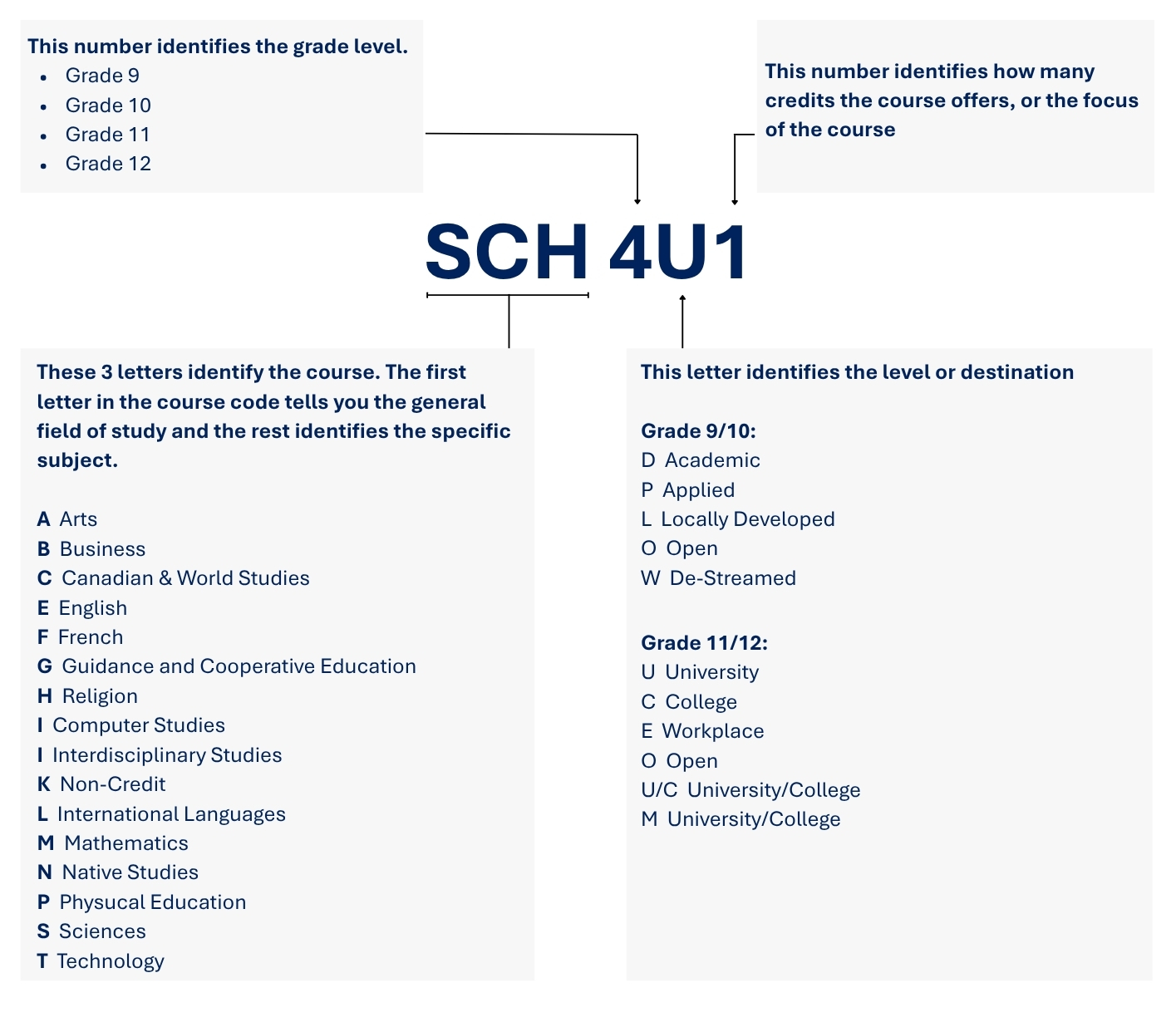
EXPLORE THE CODE
Your guide to course codes and levels.
Course Codes are decided by the Ministry of Education. All schools in Ontario use the same system for identifying courses.
STUDENT SUCCESS
E-LEARNING
What is e-learning?
An online learning course or e-learning course is defined as one which is delivered entirely on the internet and where the student is separated from the teacher by time and/or distance.
At BHNCDSB, eLearning courses are delivered asynchronously using Brightspace. On February 1, 2022, the Ministry of Education released the Policy/Program Memorandum 167 Online Learning Graduation Requirement: This requirement is designed to support students to enroll in online learning courses as part of their secondary school program, to support the development of digital literacy and other important transferable skills that will help prepare them for success after graduation and in all aspects of their lives.
Online courses are completed entirely via the Internet and students do not need to be physically present with one another or an educator in the completion of the course unless support is needed, or supervision is required for an examination.
Why take an online course?
Online courses were designed to meet the needs of our students who have issues regarding course options. Some reasons why students seek online courses are:
- To meet Graduation Requirement (opt out available)
- To accommodate difficult schedules
- To access courses that may be unavailable at the home school
- To participate in an interactive and engaging 21st century learning environment
What do I need to be a successful e-learning student?
- Have excellent time management skills
- Able to problem solve independently
- Able to navigate the internet competently
- Able to advocate for myself (know when to ask for help)
- Able to work collaboratively in an online environment (e.g., Brightspace, collaborate on a digital document, chatting in online discussion, etc.)
- Log in daily and complete required course work in a timely manner (e.g., assignments, discussions, quizzes, etc.)
- Respect the values of our Catholic faith (e.g., dignity of the human person) when communicating (e.g., use of appropriate language, tone, and awareness of and sensitivity to the feeling of others)
Opting out of the Graduation Requirement
Meeting the online learning graduation requirement should not pose a barrier to graduation for students. As with all learning, students taking online courses will have access to the supports they need through their school (e.g., guidance, Special education).
Parents/guardians may choose to opt their child out of the mandatory online courses required for graduation. Students aged 18 years of age or older or students who are 16 or 17 years of age and have withdrawn from parental control can also opt out of the graduation requirement. Students who opt out can opt back into the online learning graduation requirement should their decision change.
To opt out please fill out the eLearning Opt Out Form and submit it to your guidance counselor.
How to enroll in online courses
Online courses offered by BHNCDSB are available to students during the course selection process and will be clearly indicated as Elearning courses in My Blueprint. Students may discover they need or want a course that is not offered by BHNCDSB, in such cases, students are advised to meet with their guidance counselor who may search for available, appropriate online options offered at other boards.
COMMUNITY INVOLVEMENT GUIDE
EXPECTATION
To fulfill the requirements for Ontario Secondary School Diploma (OSSD) each student must complete a minimum of 40 hours of Community Involvement.
GUIDING PRINCIPLE
Community service provides Catholic students a valuable opportunity to respond to the Christian call to serve others, especially those “who are least among us” (Mt 25:35-36, 40), all the while fulfilling their graduation requirements, 40 hours of community service.
Alongside learning the teachings and traditions of the Catholic faith, it is vital that students have opportunities to witness their faith by reaching out to help others through Christian service.
GENERAL INFORMATION
Students may complete the requirement at any time starting in the summer before entering Grade 9 and preferably finish prior to January of their graduating year. Students may complete one activity of 40 hours or several activities which add up to 40-hour time commitment. The requirement must be completed outside of the scheduled class time.
- During the lunch hour or spare(s)
- In the evening
- During the summer
- On the weekends
- During school holidays
Students under the age of 18 years should plan and select their activities in consultation with their parents/guardians. Early completion of the 40 hours of Community Involvement is strongly recommended.
ROLES AND RESPONSIBILITIES
THE STUDENT:
- Plans activity with parents/guardians
- Secures placement(s)
- Hands in planning report to administrator/administrator designate
- Gets involved
- Obtains parents/guardian signature upon completion
- Submits documentation to administrator designate (Guidance Counsellor)
THE PARENT/GUARDIAN:
- Aids in placement selection
- Communicates with the school and placement about concerns
- Signs Notification and Completion forms if student is under 18
THE SECONDARY SCHOOL: (Guidance Counsellor)
- Approves activities before placement
- Receives documentation from student
- Records completed activity on Ontario Student Transcript
- Provides accommodation recommendations for special needs
THE SCHOOL BOARD:
- Provides for student liability coverage
- Provides planning forms through the school
- Provides reporting forms through the school
ELIGIBLE ACTIVITIES
Eligible Activities in Non-Profit Organizations
Fundraisers
-
- Canvassing
- Walk-a-thons
- Celebrity games
- Gift wrapping
- Gala events
- Famine weekends
- Sales
Sports and Recreation
-
- Coaching
- Track meets
- Summer games
- Working with a buddy
- Working at a recreation centre
- Scorekeeping
- Organizing Special Olympics events
Community Events
-
- Helping organize winter carnivals
- Parades
- Summer fairs
Community Projects
-
- Participating in food drives
- Supporting community groups
- 4-H Clubs
- Welcome Wagon
- Meals on Wheels
- St. Vincent de Paul
- Food Banks
Environmental Projects
-
- Community clean-up activities
- Flower and tree planting
- Recycling initiatives
- Beautification projects
Religious Activities
-
- Programming for children
- Child-minding
- Assisting with Sunday School
- Supporting special events
- Clerical tasks
- Altar serving
- Music ministry
- Assisting with liturgy
Office and Clerical Work
-
- Reception
- Computer work
- Mailings for volunteer and not-for-profit agencies
Youth Programs
-
- Assisting with 4-H, Scouts, and Guides programs
- Helping at drop-in centres
- Breakfast programs
- After-school programs
- March Break programs
- Leaders in Training programs
- Summer playground activities
- Camps
Working with Animals
-
- Animal care in a non-profit organization
Arts and Culture
-
- Assisting at a gallery
- Performing music
- Participating in a non-profit community theatre program
- Assisting with a library program
Activities for Individuals
-
- Assisting seniors
- Shopping assistance
- Reading and preparing letters
- Snow shoveling
- Leaf raking
- Gardening
- Lawn cutting
- Visiting patients in chronic care hospitals
- Tutoring
- Transcribing
- Reading buddy programs
School Community Programs
-
- Helping with non-credit extracurricular activities
- Student governance
- Organizing school activities (e.g., sports meets, music productions, theatre productions)
- Assisting with school events (e.g., ushering, parent/guardian nights, fundraisers)
Notes:
- Being a member of a committee, club, or organization of itself is not an eligible activity, although services provided by that committee, club or activity may be eligible, if they meet the criteria stated.
- Where an activity does not clearly fall within the guidelines, administrators have the discretion to approve areas of involvement on a case-by-case basis.
- An administrator is not obligated to approve an activity.
LIST OF INELIGIBLE ACTIVITIES
The Ministry has developed a list of activities that may not be chosen as community involvement activities. These are referred to as ineligible activities. An ineligible activity is an activity that:
- Is a requirement of a class or course in which the student is enrolled (e.g., Cooperative Education, any portion of a course, job shadowing, and work experience)
- Takes place during the time allotted for the instructional program on a school day. However, an activity that takes place during a student’s lunch breaks or “spare” period(s) is permissible
- Takes place in a logging or mining environment, if the student is under sixteen years of age
- Take place in a factory if the student is under fifteen years of age
- Take place in a workplace other than a factory, if the student is under fourteen years of age and is not accompanied by an adult
- Would normally be performed for wages by a person in the workplace
- Involves the operation of a vehicle, power tools, or scaffolding
- Involves the administration of any type or form of medication or medical procedure to other persons
- Involves handling of substances classed as “designated substances” under the Occupational Health and Safety Act
- Requires the knowledge of a tradesperson whose trade is regulated by the provincial government
- Involves banking or the handling of securities, or the handling of jewelry, works of art, antiques, or other valuables
- Consists of duties normally performed in the home (i.e.: daily chores) or personal recreation activities
- Construction before 16 years of age
- Involves the activities for a court-ordered program (i.e.: community service) program for young offenders, probationary program)
- Involves simple membership in a school or community club
- Is part of a Community Service Day during regular scheduled class time
Notes:
- Student activities are not to displace paid workers
- Profit earning companies are not eligible placements
FREQUENTLY ASKED QUESTIONS
- Can I babysit for theneighbouror help a relative?
- Only if there is evidence of a serious need, e.g., a Special Needs child, no money to pay a babysitter, or other services etc.
- Can Icoach fora hockey/swimming/basketball club?
- Only if it is for a non-profit organization.
- Can the hours spent on the pilgrimage, March for Life,Thinkfast, Relay for Life or mission trips be considered for volunteer hours?
- Yes, check with youradministratorfor the allotted hours.
- Can I volunteer to teach dance at a local dance studio?
- Only if it is for a non-profit organization.
INSURANCE NOTICE
LIABILITY INSURANCE FOR COMMUNITY INVOLVEMENT DIPLOMA REQUIREMENT
The program is mandated by the Ministry, and managed by the administrator, with school board involvement on the types of activities and the forms to be completed for the program. This meets all the criteria for the board’s liability insurance to apply in the same way as it does for Co-op or “Take Our Kids to Work” programs.
The board’s liability insurance will protect the students and the community sponsors for liability lawsuits that may arise from the students’ activities in the community involvement program for the 40 hours required.
As with programs such as “Take Our Kids to Work”, the board’s insurance does not cover the sponsors for lawsuits that arise from their negligence, or for student injuries in the work place. The liability insurance of the community sponsors would be expected to respond to cover the sponsors for suits arising out of their negligence.
Ontario School Boards’ Insurance Exchange (OSBIE) will not be issuing certificates of insurance for community sponsors. Coverage falls within the liability policy terms and conditions. Certificates would be redundant. For those community sponsors who are looking for a statement about the school board’s insurance, a copy of this memorandum may be provided. As an alternative, we have also provided a guideline of a statement on the back of this memorandum.
The Ministry has provided a list of ineligible activities. School boards are asked to review the list and add to it if they wish. In addition, school boards are asked to draw up an approved list of activities. This is to be attached to the information that is provided to the student, parents/guardians, and community sponsors. We would encourage boards to share their list of approved and ineligible activities with OSBIE. We will initial the lists and return them to you, with our comments or concerns.
The Community Involvement program can be a positive experience for the students and the sponsor organizations. Clear information, good communication, and a “safety first” attitude will ensure the success of this new program.
LIABILITY INSURANCE COVERAGE FOR THE BRANT HALDIMAND NORFOLK CATHOLIC DISTRICT SCHOOL BOARD HIGH SCHOOLS’ COMMUNITY INVOLVEMENT PROGRAM
The Brant Haldimand Norfolk Catholic District School Board is pleased to advise our Community Sponsors that students who are performing volunteer work for your organizations are protected by the school board’s liability insurance, while they are performing their required forty hours of community involvement service. Community sponsors are also protected by the board’s liability insurance for claims that arise out of our students’ volunteer activities for your organizations.
For example, if a student, during his/her volunteer duties, causes damage or injures a third party, and this results in a lawsuit against the student and the community sponsor, the board’s insurance will protect both the student and the community sponsor.
Community sponsors will be responsible for ensuring that their liability insurance will protect them for their involvement in this program. As with other programs, such as “Take Our Kids to Work”, the school board’s insurance does not provide coverage for the negligence of the community sponsors.
Community sponsors should also be aware that, like job shadowing and other similar work-experience programs, students do not have accident insurance, nor Workplace Safety Insurance coverage through the school board. It is recommended that students involved in the program purchase Student Accident Insurance. The school board expects the community sponsors to ensure that student volunteers are provided with safety instructions and are trained and supervised to ensure a safe and mutually beneficial volunteer experience.
HOW TO GET STARTED
- In consultation with your parents/guardians, CHOOSE a community involvement activity (parents/guardian signature is not required if the student is eighteen years of age or older).
- Contact the person or organization to explore the possibility of a volunteer activity.
- Volunteer fairs are hosted periodically by the city
- Contact public institutions
- Contact regional or local governments i.e., www.norfolkcounty.ca
- Check volunteer opportunities in Guidance departments
- Contact service clubs to assist with some of their projects
- Contact local library and Information Centres for a list of agencies in the community.
- Ensure that no activities from the list of ineligibles appear on this form
- Complete the Notification and Completion of Activities section in the Community Involvement Activity Record
- Submit the form to Student Services at the requested date (specific times will be announced at your school)
- Check the “Completion of Graduation Requirements” form is attached to your final report card and accurately reflects the community hours completed
- Be responsible. You are responsible for the management of this document; know where it is kept and keep it updated
- Please keep a copy for your records